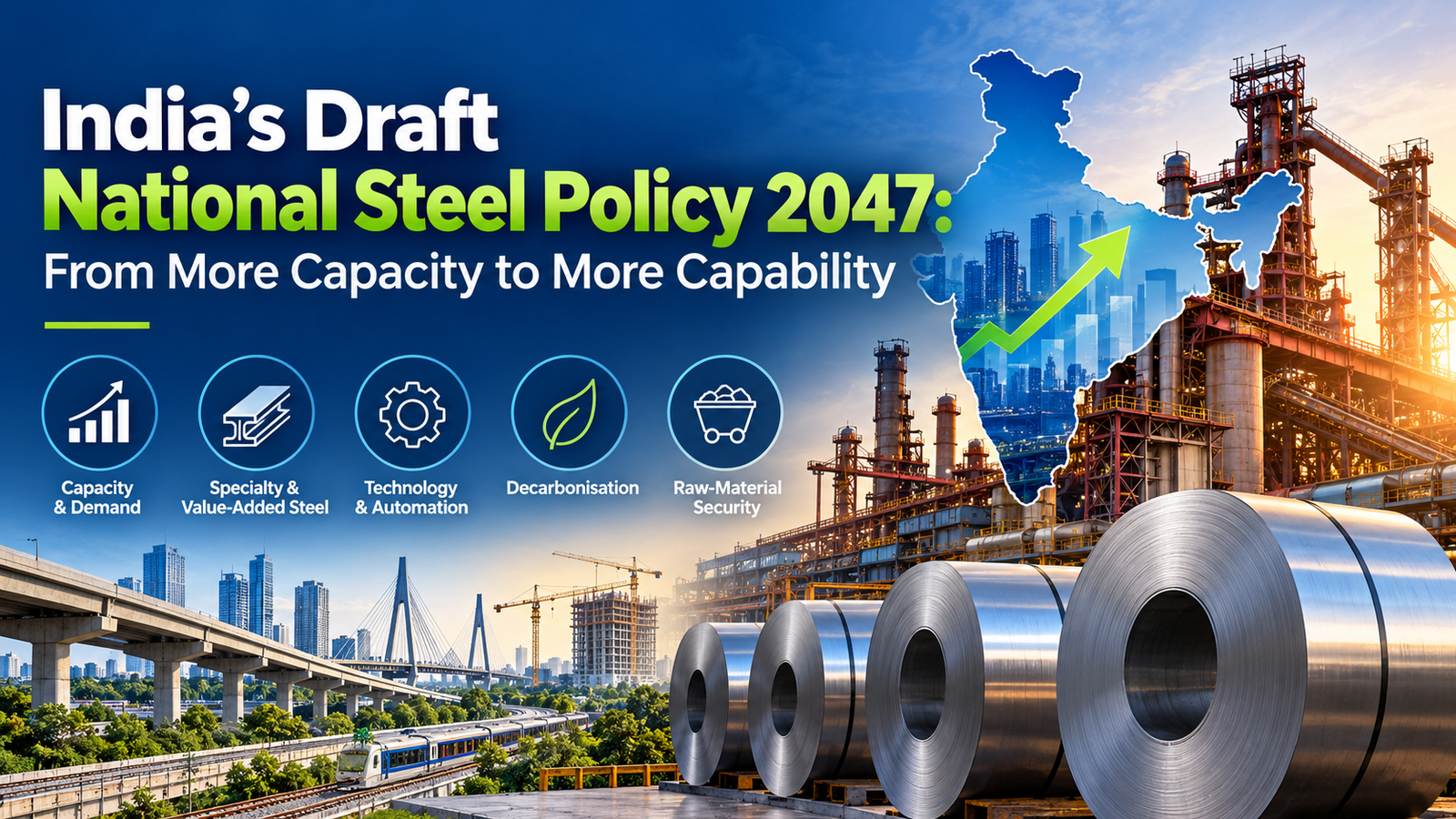
India’s Draft National Steel Policy 2047: From More Capacity to More Capability
India’s long-term steel ambitions go beyond expanding production.
The proposed policy points towards a more competitive, technology-driven,
value-added and lower-carbon steel industry.
Steel is central to India’s infrastructure development, industrial growth
and manufacturing ambitions. From construction and railways to automobiles,
defence and energy, steel demand is closely linked to the country’s economic development.
The draft National Steel Policy 2047 outlines an ambitious long-term vision
for the sector. Alongside higher production and consumption, it highlights
the importance of specialty steel, technological advancement, raw-material
security and decarbonisation.
Key Proposed Targets
The draft policy proposes the following long-term targets for India’s steel industry:
600+ MTProposed steelmaking capacity by 2047
500+ MTProposed steel consumption
45 MTApproximate exports, including steel embedded in manufactured products
ValueGreater emphasis on specialty and value-added steel
LowerCarbon emissions and production intensity
StrongerDomestic technology and raw-material capabilities
Key takeaway: The proposed direction is not simply to
produce more steel, but to strengthen the quality, competitiveness,
resilience and sustainability of India’s steel ecosystem.
Five Key Areas of Focus
01Capacity Expansion and Domestic Demand
India will require substantial steel supplies to support infrastructure,
construction, automobiles, defence, railways, energy and manufacturing.
Increasing capacity can help the industry respond to growing domestic
requirements and emerging export opportunities.
However, long-term competitiveness will depend on more than production
volumes. Manufacturers will also need to deliver the right grades,
consistent quality and specialised products required by increasingly
demanding industrial applications.
02Specialty and Value-Added Steel
A stronger focus on specialty and value-added steel can help India
address the requirements of high-performance industries and reduce
reliance on imported grades.
Developing these capabilities can create opportunities for advanced
manufacturing, product innovation and deeper integration with domestic
and global industrial supply chains.
03Technology, Automation and Productivity
Technology adoption will be an important lever for improving the
performance of steel plants. Artificial intelligence, automation,
data analytics and advanced process control can support better
decision-making across production and operations.
Potential benefits include improved product quality, reduced process
variation, predictive maintenance, lower energy consumption and better
cost control. Translating these technologies into measurable operational
improvements will be essential for manufacturers.
04Decarbonisation and Sustainable Steelmaking
Reducing the carbon intensity of steel production is becoming an
increasingly important industry priority. Energy efficiency, greater
scrap utilisation, renewable electricity, cleaner fuels and hydrogen-based
technologies may contribute to lower-emission production pathways.
Carbon capture may also have a role where technically and economically
feasible. The appropriate approach will vary depending on production
routes, plant configuration, energy availability and investment capacity.
The proposed ₹5,000 crore support scheme for small steel producers,
as outlined in the supplied policy summary, also highlights the need
to improve efficiency and reduce emissions in the secondary steel sector.
05Raw-Material Security and Domestic Capabilities
Higher steel production will require reliable, competitive access to
iron ore, coking coal, scrap and other critical inputs. Supply
disruptions, price volatility and import dependence can affect
manufacturing costs and operational resilience.
Strengthening raw-material planning, supply chains, domestic technical
capabilities and resource efficiency will be important for the sector’s
long-term growth. Greater resilience can help steelmakers manage market
uncertainty while supporting India’s broader manufacturing ambitions.
What This Means for India’s Steel Industry
The draft National Steel Policy 2047 presents a vision that combines
scale with capability. Capacity expansion can support rising demand,
but sustained competitiveness will also require innovation, specialised
products, efficient operations, cleaner production and secure supply chains.
For steel producers, equipment manufacturers, technology providers and
industrial stakeholders, these priorities point to opportunities to
modernise operations, strengthen value-added production and build
capabilities for the next phase of industrial growth.
The broader challenge is to ensure that India’s steel sector grows
not only in size, but also in productivity, technological depth,
sustainability and global competitiveness.
Building Capability for Sustainable Industrial Growth
Explore how strategic consulting, operational improvement and
technology-led transformation can support business performance.
Editorial note: This article summarises the proposed
direction and targets described in the supplied draft-policy brief.
Figures and proposed measures should be checked against the latest
official policy document before publication. Draft proposals may change
and should not be interpreted as final government commitments.